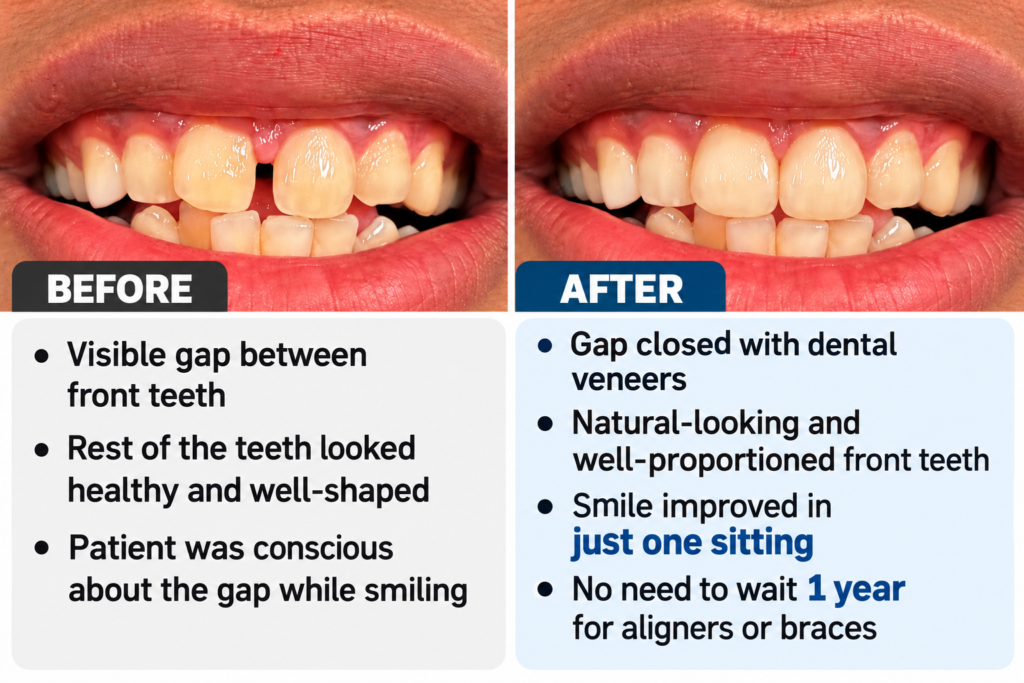
Why spend a year correcting a small gap when a carefully planned smile makeover could give you the result you want in just one sitting?
A patient visited Dental World, Rajouri Garden, with a common cosmetic concern: a visible gap between the front teeth. The rest of the teeth looked good, were well-shaped, and did not need major cosmetic changes.
The patient wanted a more complete, confident smile without committing to months of orthodontic treatment.
After evaluating the smile and discussing the available options, veneers offered a potential solution. Instead of gradually moving the teeth with braces or aligners, the treatment focused on improving the appearance of the front teeth and closing the visible gap.
The result? A smile makeover completed in a single sitting, without the lengthy treatment journey that orthodontics might have involved.
The Patient’s Concern: One Gap, One Big Difference
The patient was happy with the overall appearance of their teeth. The problem was the space between the two front teeth, also known as a midline diastema.
Even when the rest of the teeth look attractive, a noticeable gap can draw attention whenever someone smiles or speaks.
The patient wanted three things:
- Close the gap between the front teeth.
- Maintain a natural-looking smile.
- Avoid a long treatment period if a suitable alternative existed.
The key was to select a treatment that addressed the actual concern without unnecessarily changing the rest of the smile.
Why Braces or Aligners Could Have Taken Around a Year
Braces and clear aligners work by gradually moving natural teeth into new positions. They are effective treatments, but they require time, planning, and patient compliance.
For this patient, orthodontic treatment was estimated to take approximately one year, subject to the final clinical assessment.
What could have made the journey difficult?
1. Months of treatment
The patient would have needed to attend follow-up appointments and wait for the teeth to move gradually into position.
2. Daily commitment with clear aligners
Aligners generally need to be worn for around 20–22 hours a day, depending on the prescribed system. They must be removed for eating and drinking anything other than water, then cleaned and reinserted.
3. Dietary restrictions and cleaning with braces
Fixed braces can make brushing and flossing more challenging. Certain hard or sticky foods may also need to be avoided to reduce the risk of damaging the appliance.
4. Retainers after treatment
Closing a gap orthodontically does not always mean the gap will stay closed permanently without maintenance. Retainers are commonly needed to help prevent teeth from moving back.
For someone whose primary concern is a small cosmetic gap, this commitment may feel excessive — provided a less invasive and clinically appropriate alternative is available.
The Quick Fix: How Veneers Closed the Gap
Veneers are thin, custom-made coverings bonded to the front surfaces of teeth. They can improve tooth shape, proportions, colour, and the appearance of spaces between teeth.
Unlike braces or aligners, veneers do not gradually move teeth. Instead, they change the visible contours of the teeth to create the desired cosmetic result.
For a suitable patient with otherwise well-shaped teeth, this can be a much faster approach.
Step 1: Smile Assessment and Treatment Planning
The dentist examines the teeth, gums, bite, and size of the gap. Photographs and other diagnostic records may be taken to plan the final appearance.
The dentist also checks whether the gap is associated with gum disease, a prominent frenum, missing teeth, or other factors that may require attention before cosmetic treatment.
Step 2: Designing the New Smile
The dentist determines the appropriate width, length, shape, and proportions of the front teeth.
The objective is not simply to hide the gap. It is to create a balanced smile that suits the patient’s facial features while avoiding teeth that look unnaturally wide or bulky.
Step 3: Preparing the Teeth, If Required
Depending on the veneer material and the case, a small amount of enamel may need to be removed to achieve a natural fit and appearance.
Some veneer techniques require little or no preparation, but they are not suitable for every patient. The dentist should explain the preparation required and the long-term implications before treatment begins.
Step 4: Bonding the Veneers
The veneers are fitted and bonded to the front surfaces of the selected teeth. The dentist checks the margins, shape, shade, bite, and overall symmetry before completing the procedure.
When the case is suitable and the veneers are ready, the treatment can be completed in a single sitting.
Step 5: The Final Smile
The visible gap is closed by changing the shape and proportions of the front teeth. The patient can leave with a more uniform-looking smile without waiting for months of gradual tooth movement.
The exact result depends on the starting condition, veneer design, material, and clinical suitability.
How Much Time and Money Could the Patient Save?
The main advantage in this case was the shorter treatment timeline. If orthodontic treatment would have taken approximately 12 months and the veneer procedure was completed in one sitting, the patient avoided that extended treatment period.
However, a shorter treatment does not automatically mean a cheaper treatment.
The total cost of braces or aligners depends on the provider, treatment complexity, retainers, and follow-up care. Veneer costs depend on the number of teeth treated, the material, laboratory work, and the dentist’s fees.
To calculate the actual financial saving, both treatment plans must be compared using real quotations.
There is also an important long-term consideration: veneers may need maintenance, repair, or replacement in the future. Braces and aligners, meanwhile, preserve the natural tooth structure, although they also require retention and follow-up care.
For this patient, the appeal was the ability to address a specific cosmetic concern quickly rather than commit to a year-long orthodontic journey.
Veneers vs. Braces vs. Aligners
| Feature | Veneers | Braces | Clear aligners |
| Main purpose | Improve visible tooth appearance | Move natural teeth | Move natural teeth |
| Typical timeline | One sitting in suitable cases | Months to years | Months to years |
| Closes a visible gap | Yes, in suitable cases | Yes | Yes |
| Removes natural enamel | May require it | No | No |
| Requires daily appliance wear | No | Fixed appliance | Yes |
| Retainers after treatment | Not for tooth movement, though maintenance is needed | Usually | Usually |
Are Veneers Always the Better Choice?
No. A fast cosmetic result should never be the only consideration.
If the teeth are healthy and the gap is caused by tooth positioning, orthodontic treatment may be the better long-term option. It corrects the position of natural teeth rather than disguising the gap by changing their shape.
Veneers can be appropriate when the teeth are otherwise suitable and the gap can be closed without creating excessively wide-looking teeth or compromising the bite.
Veneers can also involve irreversible enamel removal. The dentist should explain this trade-off before proceeding.
The Takeaway: A Small Gap Doesn’t Always Need a Year of Treatment
This case highlights an important point: the best treatment depends on the actual dental problem, not just the available procedures.
For a suitable patient with well-shaped teeth and a small gap in the front teeth, veneers may provide a faster cosmetic solution — potentially in one sitting instead of an estimated year of aligners or braces.
At Dental World, Rajouri Garden, the aim is to identify the treatment that fits each patient’s dental condition, smile goals, timeline, and long-term oral health.
Have a gap in your front teeth? Book a consultation to find out whether veneers, braces, or clear aligners are the right option for you.