Introduction: When a Previously Treated Tooth Needs Another Root Canal
Root canal treatment is designed to remove infected or inflamed tissue from inside a tooth, clean and disinfect the root canal system, and seal it to help preserve the natural tooth.
However, not every root canal treatment achieves the desired outcome on the first attempt. Some teeth have complex internal anatomy, including narrow, curved, or branching canals that can be difficult to identify and treat.
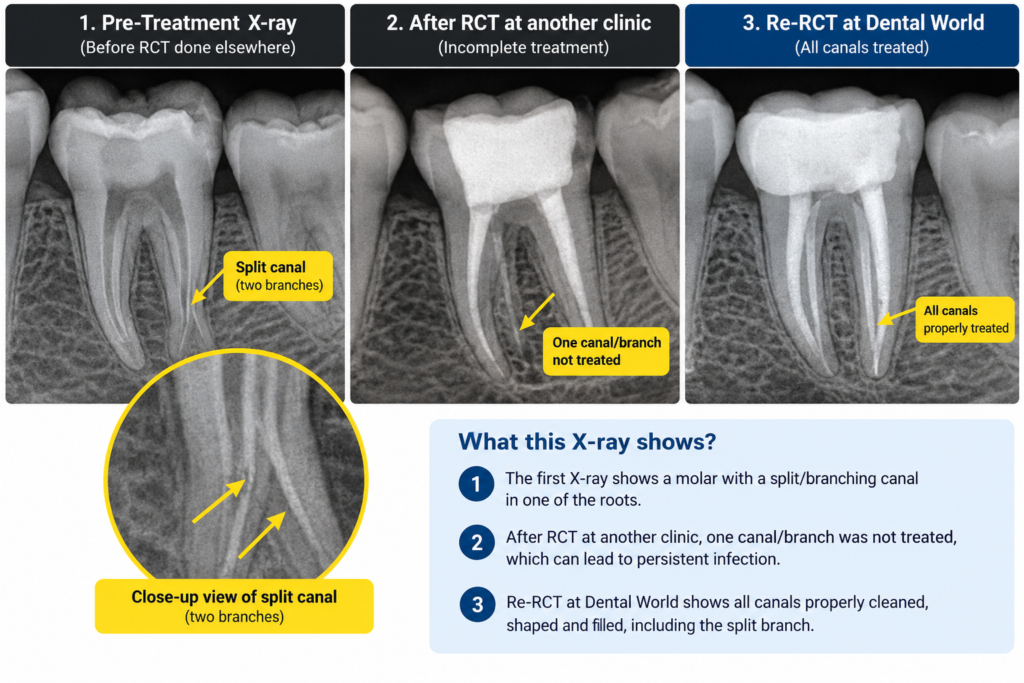
At Dental World, Rajouri Garden, Delhi, a patient was referred to us for re-root canal treatment (Re-RCT) after undergoing an unsuccessful root canal procedure elsewhere. The case required careful evaluation because of the complex canal anatomy in the affected molar tooth, including a canal pathway that reportedly divided into branches.
This case highlights an important fact about endodontic treatment: successful treatment depends not only on performing the procedure but also on identifying and adequately treating the entire root canal system.
Understanding the Case: A Molar With Complex Root Canal Anatomy
The patient came to Dental World following a referral from another person. The tooth had already undergone root canal treatment at another clinic, but further treatment was considered necessary.
During the assessment, the team focused on the internal anatomy of the molar and the possibility that a branching canal pathway had not been adequately treated during the initial procedure.
Molar teeth are particularly challenging because their internal anatomy can be complicated. Depending on the tooth, they may contain several canals, narrow passages, curved roots, and anatomical variations that are not always easy to identify on a standard dental X-ray.
In this case, the reported split in one of the canal pathways was an important consideration in planning the retreatment.
Why does this matter?
If a branch or additional canal is not adequately cleaned, disinfected, and sealed, bacteria and infected tissue may remain inside the root canal system. This can contribute to persistent or recurring infection and may compromise the outcome of the original treatment.
What Is Re-RCT, and Why Is It Needed?
Re-RCT stands for root canal retreatment. It is a procedure performed when a previously treated tooth requires further endodontic treatment.
The decision to perform retreatment depends on the clinical findings, the tooth’s restorability, the condition of the surrounding tissues, and the likely cause of the previous treatment failure.
Some possible reasons for an unsuccessful root canal include:
- Missed or untreated canals: Complex anatomy may make some canal pathways difficult to identify.
- Persistent bacterial infection: Bacteria may remain in areas that were not adequately cleaned or disinfected.
- Inadequate root canal filling: Parts of the canal system may not have been properly sealed.
- Coronal leakage: A defective or delayed final restoration may allow bacteria to enter the treated tooth.
- Complex root anatomy: Curved, narrow, or branching canals can make treatment more challenging.
In this patient’s case, the suspected branching canal anatomy was a key concern. However, the precise reason for the previous treatment failure should be established from the clinical examination and available radiographs rather than assumed from anatomy alone.
Why a Split or Branching Root Canal Can Make Treatment Difficult
A root canal is not always a single, straight passage from the top of the tooth to the root tip.
Some canals divide into smaller pathways or contain anatomical irregularities. These variations can make it difficult to clean every part of the system thoroughly.
Consider what happens when a canal divides into two branches. If one pathway is not identified or adequately treated, bacteria may persist in that area even if the main canal appears to have been filled.
This is why complex root canal cases require a systematic approach to diagnosis and treatment.
Depending on the case, the dentist may use:
- Clinical examination and appropriate dental X-rays.
- Careful assessment of the existing root canal filling.
- Magnification and enhanced illumination, where available.
- Appropriate canal-finding and cleaning techniques.
- Additional imaging, such as cone-beam computed tomography (CBCT), when clinically justified.
CBCT is not necessary for every root canal retreatment. It may be considered when conventional examination and imaging do not provide sufficient information about complex anatomy or suspected complications.
How Root Canal Retreatment Is Approached
The exact procedure depends on the tooth’s anatomy and the findings from the initial examination. A typical nonsurgical retreatment may involve the following steps.
1. Examination and Diagnosis
The dentist evaluates the tooth, reviews the previous treatment where possible, and takes appropriate radiographs. Symptoms, tenderness, swelling, and the condition of the surrounding tissues may also be assessed.
2. Accessing the Previously Treated Tooth
The dentist gains access to the root canal system. Depending on the existing restoration, it may be necessary to remove some or all of the previous filling material or restorative components.
3. Removing the Previous Root Canal Filling
The existing root canal filling material is removed as required to allow further examination, cleaning, and disinfection of the canal system.
4. Identifying the Canal Anatomy
The dentist evaluates the canal pathways and looks for missed canals, branches, or other anatomical features that may affect treatment.
This stage is especially important in molars with complex root canal anatomy.
5. Cleaning and Disinfection
The canals are cleaned and disinfected using appropriate endodontic instruments and irrigation protocols. The aim is to reduce bacterial contamination and prepare the canal system for sealing.
6. Sealing the Root Canal System
Once the dentist determines that the canals are appropriately prepared, they are filled and sealed according to the clinical requirements.
7. Final Restoration and Follow-Up
A suitable final restoration is essential to protect the treated tooth and reduce the risk of reinfection. Depending on the amount of remaining tooth structure and the forces placed on the tooth, a crown may be recommended.
Follow-up assessment helps the dentist evaluate healing and the long-term outcome.
The steps described above are a general explanation of retreatment, not a confirmation that every step was performed in this particular patient’s case.
Can a Failed Root Canal Be Saved?
In many cases, yes. A tooth that has not responded successfully to its initial root canal treatment may still be suitable for retreatment.
However, the outcome depends on several factors, including:
- The extent of infection and any damage around the root.
- Whether the complete canal system can be accessed and treated.
- The presence of cracks, fractures, or significant structural damage.
- The amount of healthy tooth structure remaining.
- The quality of the final restoration.
If nonsurgical retreatment is not suitable, the dentist may discuss other options, such as endodontic surgery or extraction, depending on the diagnosis.
No treatment can guarantee success. The most appropriate option should be selected after examining the tooth and discussing the expected benefits, limitations, and alternatives with the patient.
When Should You Consult a Dentist After a Root Canal?
A root canal-treated tooth should not be ignored if symptoms persist or return.
Consider arranging a dental evaluation if you experience:
- Persistent or recurring pain.
- Pain while biting or chewing.
- Swelling around the treated tooth.
- A recurring gum boil or discharge near the tooth.
- A damaged, loose, or missing restoration.
- New symptoms after a period without discomfort.
Some teeth with persistent infection may produce few symptoms. Therefore, a clinical and radiographic assessment may be appropriate even when pain is absent.
Facial swelling accompanied by fever, rapidly increasing swelling, or difficulty swallowing or breathing requires urgent medical or dental attention.
The Importance of Specialist Evaluation in Complex Root Canal Cases
This case demonstrates why complex root canal retreatment requires careful diagnosis and an understanding of root canal anatomy.
A molar may look normal from the outside while containing a complicated network of canals internally. Identifying the reason for a previous treatment failure is an important step in deciding how to proceed.
Patients should understand that a failed root canal does not automatically mean the tooth must be extracted. In suitable cases, retreatment may offer an opportunity to preserve the natural tooth.
Looking for Root Canal Retreatment in Rajouri Garden, Delhi?
At Dental World, Rajouri Garden, patients can seek an evaluation for previously treated teeth that continue to cause discomfort or show signs of persistent infection.
If you have been advised to undergo Re-RCT, bring your previous dental X-rays and treatment records, if available. These can help the dentist assess the existing treatment and determine the next steps.
Dental World – Rajouri Garden
- Address: A-2/132, Block A, Rajouri Garden, New Delhi
- Consultation Fee: ₹500
- Phone: 9990844321 | 9650044321
Contact Dental World to arrange a consultation and discuss whether root canal retreatment is appropriate for your tooth.
Frequently Asked Questions
1. What is Re-RCT in dentistry?
Re-RCT is root canal retreatment. It involves reopening and treating a previously root canal-treated tooth when further treatment is needed because of persistent infection, missed canals, or other endodontic problems.
2. Why can a root canal fail in a molar tooth?
Molars often have multiple canals and complex anatomy. Missed canals, persistent bacteria, inadequate sealing, coronal leakage, and other complications can contribute to treatment failure.
3. Can a split root canal cause a failed RCT?
A branching canal can make treatment more challenging. If a branch remains inadequately cleaned or sealed, infection may persist. However, a branching canal alone does not prove that the original treatment was performed incorrectly.
4. Does every failed root canal require extraction?
No. Some teeth can be preserved through nonsurgical retreatment or, in selected cases, endodontic surgery. The decision depends on the tooth’s condition and restorability.
5. Is root canal retreatment painful?
Retreatment is generally performed under local anaesthesia. Some tenderness may occur afterwards, and the level of discomfort varies. Your dentist can explain what to expect based on your case.
6. How much does a root canal consultation cost at Dental World?
The consultation fee at Dental World, Rajouri Garden, is ₹500. The cost of retreatment depends on the tooth, complexity, and treatment required.
Important clinical note: This article describes a case based on the information provided and is intended for patient education. The final published version should reflect the actual examination findings, X-rays, treatment performed, and clinical outcome. Patient consent should be obtained before publishing identifiable clinical photographs or records.