A Realistic Dental Case Study | Dental World
Not every dental problem begins with a toothache. Sometimes, the warning signs appear somewhere else – persistent jaw discomfort, repeated swelling near the back of the mouth, difficulty chewing or an uncomfortable feeling while opening the mouth.
This was the situation with one patient who visited Dental World after experiencing repeated swelling at the back of the mouth along with jaw pain. Surprisingly, the patient had no noticeable toothache and initially did not suspect that a tooth was responsible.
After a proper dental examination and an X-ray, the underlying problem became clear: an impacted wisdom tooth was causing recurring inflammation and infection.
Let’s understand what happened, how the problem was diagnosed and why treating the wisdom tooth was important.
The Patient’s Story: Jaw Pain Without Any Toothache
A patient visited Dental World with complaints of discomfort around the lower jaw. For several weeks, the patient had been experiencing occasional swelling towards the back of the mouth, particularly around the area behind the last molar.
The symptoms would sometimes settle down, only to return after a few days or weeks.
The patient’s main complaints were:
- Repeated swelling near the back of the lower jaw.
- Discomfort while chewing food.
- Pain extending towards the jaw.
- Tenderness around the last molar.
- Occasional difficulty opening the mouth comfortably.
Interestingly, there was no significant toothache.
Since the patient wasn’t experiencing typical tooth pain, the problem initially seemed unrelated to the teeth. However, recurring swelling in the same area suggested that something deeper needed investigation.
The Dental Examination: What Was Actually Causing the Problem?
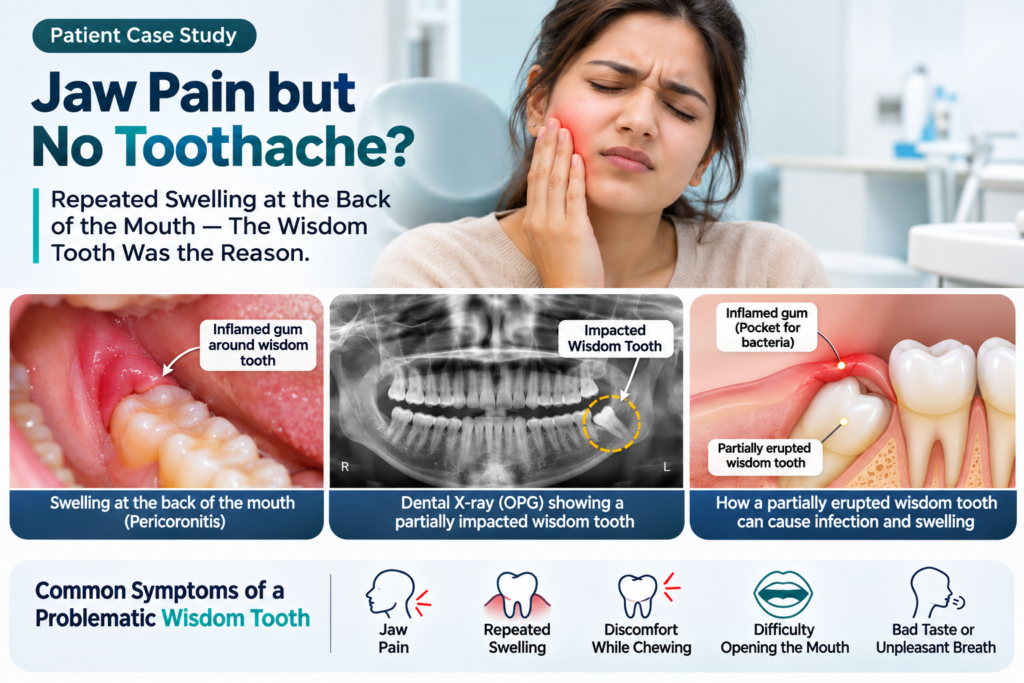
During the clinical examination, the dentist noticed inflammation around the gum tissue behind the last lower molar.
Further examination suggested that the wisdom tooth had not erupted completely. It was partially covered by gum tissue, creating a small space where food particles and bacteria could accumulate.
To investigate the position of the tooth and its surrounding structures, a panoramic dental X-ray (OPG) was advised.
The X-ray revealed a partially impacted wisdom tooth positioned at an angle beneath the gum line.
The area surrounding the partially erupted tooth was inflamed, indicating a condition known as Pericoronitis.
This explained why the patient was experiencing repeated swelling and jaw discomfort despite having no direct toothache.
What Is Pericoronitis? Why Does a Wisdom Tooth Cause Swelling?
Pericoronitis is an inflammation or infection of the gum tissue surrounding a partially erupted tooth, most commonly a wisdom tooth.
Wisdom teeth are the last molars to develop, usually emerging between the ages of 17 and 25. However, there is often insufficient space at the back of the jaw for them to erupt properly.
As a result, a wisdom tooth may:
- Remain completely trapped beneath the gum.
- Erupt only partially.
- Grow at an angle and press against the neighbouring molar.
- Become partially covered by a flap of gum tissue.
When a tooth is only partially erupted, the gum flap can create a pocket where food debris and bacteria become trapped.
This can lead to repeated inflammation, swelling and infection.
Why does it cause jaw pain without a toothache?
The inflammation may affect the surrounding gum tissue and soft tissues at the back of the mouth. This can produce discomfort around the jaw, pain while chewing and sometimes difficulty opening the mouth.
The wisdom tooth itself does not necessarily have to be decayed or painful for these symptoms to develop.
The Treatment: Addressing the Actual Cause
After evaluating the clinical findings and X-ray, the dentist explained that the recurring swelling was associated with the partially impacted wisdom tooth.
The treatment approach involved addressing the active inflammation and planning definitive treatment for the underlying cause.
Step 1: Managing the Infection and Swelling
The affected area was examined and cleaned to remove trapped food debris and bacterial accumulation.
Depending on the severity of infection, the dentist may recommend appropriate medication. Antibiotics are not routinely necessary for every case of pericoronitis and are generally reserved for cases with spreading infection or systemic symptoms.
Step 2: Wisdom Tooth Removal
Because the tooth was partially impacted and associated with recurring inflammation, extraction was recommended as the definitive treatment.
Once the acute inflammation was appropriately managed, the wisdom tooth was removed through a planned dental extraction procedure.
The procedure may involve a small incision in the gum, removal of a limited amount of surrounding bone when necessary, and sectioning the tooth into smaller pieces to facilitate removal.
The exact technique depends on the tooth’s position and root anatomy.
Step 3: Post-Treatment Care
After the procedure, the patient was given instructions regarding oral hygiene, eating habits and recovery.
The patient was advised to:
- Follow the dentist’s post-extraction instructions.
- Avoid disturbing the surgical area.
- Maintain gentle oral hygiene.
- Avoid smoking during the healing period.
- Attend the recommended follow-up appointment.
The Outcome: Why Early Diagnosis Matters
The main objective of treatment was to eliminate the source of repeated inflammation rather than simply provide temporary relief from swelling.
Once the underlying cause was addressed, the patient could focus on recovery without the same partially impacted tooth continuing to create a pocket for bacterial accumulation.
This case highlights an important point: Jaw pain and repeated swelling can sometimes be signs of a wisdom tooth problem, even when there is no toothache.
5 Warning Signs Your Wisdom Tooth May Be Causing Problems
If you experience any of the following symptoms, consider getting your wisdom teeth examined:
- Repeated Gum Swelling: Swelling behind the last molar that keeps returning.
- Jaw Discomfort: Pain or stiffness around the back of the jaw.
- Difficulty Opening Your Mouth: Inflammation can make normal mouth movements uncomfortable.
- Pain While Chewing: Pressure on the inflamed gum tissue can cause discomfort during eating.
- Bad Taste or Unpleasant Breath: Trapped food and bacterial accumulation around a partially erupted wisdom tooth can cause an unpleasant taste or odour.
If you develop facial swelling, fever, difficulty swallowing or difficulty breathing, seek urgent medical or dental attention. Breathing or swallowing difficulties require emergency assessment.
Frequently Asked Questions
1. Can an impacted wisdom tooth cause jaw pain without a toothache?
Yes. An impacted or partially erupted wisdom tooth can cause inflammation in the surrounding gum tissue, resulting in jaw discomfort, swelling and difficulty chewing without producing direct tooth pain.
2. Why does wisdom tooth swelling keep coming back?
When a wisdom tooth is partially covered by gum tissue, food particles and bacteria can accumulate underneath the gum flap. This can lead to repeated episodes of inflammation known as pericoronitis.
3. Does every impacted wisdom tooth need to be removed?
No. Not every impacted wisdom tooth requires extraction. If it is healthy, symptom-free and not damaging neighbouring structures, monitoring may be appropriate. However, recurring infection, damage to adjacent teeth or other pathology may make extraction necessary.
4. Is wisdom tooth removal painful?
The procedure is generally performed under local anaesthesia, which numbs the treatment area. Patients may experience pressure during extraction and some pain or swelling during recovery. The level of discomfort depends on the complexity of the extraction.
5. How is an impacted wisdom tooth diagnosed?
A dentist examines the gums, surrounding teeth and jaw. Dental X-rays, particularly panoramic OPG imaging, help assess the tooth’s position, roots and relationship with neighbouring structures.
Don’t Ignore Repeated Swelling at the Back of Your Mouth
A recurring dental problem should never be dismissed simply because it doesn’t cause a toothache.
As this case demonstrates, an impacted wisdom tooth can remain unnoticed while repeatedly causing inflammation, swelling and jaw discomfort.
Early dental evaluation can help identify the actual cause, prevent complications and determine whether monitoring or treatment is required.
Experiencing jaw pain or repeated swelling near your wisdom teeth?
Visit Dental World for a professional dental examination and appropriate treatment guidance.
Book your dental consultation today.